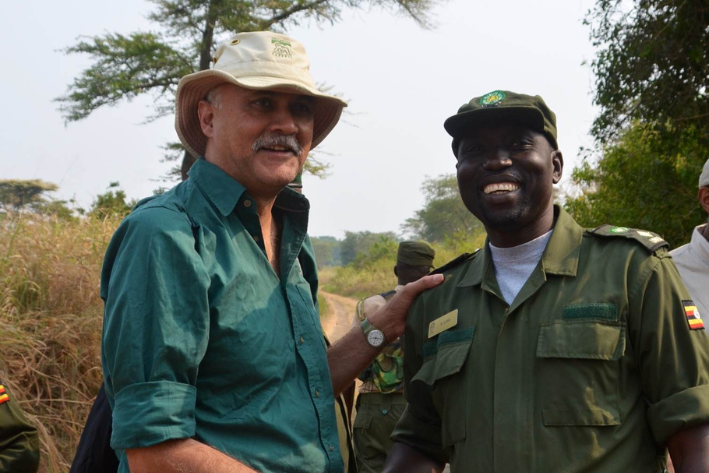
Podcast: Greg Campher from Sambora Kinigi
Greg Campher built Sambora Kinigi for the guests who wanted to stay longer than the gorilla trek, and leave having seen what the rest of Rwanda actually looks like.
Podcast: Greg Campher on Building Sambora Kinigi in Rwanda
Greg Campher did not go to Rwanda to open a safari lodge. He went to set up a coffee project for a genocide memorial trust and ended up staying.
Sambora sits on the foothills of the Virunga volcanoes in Kinigi, the small highland town that serves as the gateway to Volcanoes National Park and the mountain gorillas that live inside it. The whole world passes through Kinigi to tick something off a bucket list. Greg and his business partner Sam Borah decided to build a lodge that was worth staying in rather than rushing through. Shaun sat down with Greg to talk about how a background in speciality coffee leads to a nine-room lodge in the Virunga foothills, and what it actually means to visit Rwanda properly.


From Coffee Farms to Virunga Foothills
Greg grew up in Johannesburg, doing what most South African families did: Kruger, Thornybush, the classic bush circuit. He always assumed a safari lodge would be his retirement project. It arrived about twenty years early. His path there ran through coffee. Since 2008, he had been working on speciality coffee projects across the continent, and in Rwanda he was setting up a project for the Aegis Trust, the organisation that helped the Rwandan government establish the Kigali Genocide Memorial. Their work in peace and values education, carried into rural communities through networks of doctors and teachers, was the kind of thing Greg had not imagined people doing. He wanted to support it.
Sam Borah, who became Greg’s business partner, had already been in Rwanda for fifteen or sixteen years through his own work with Aegis. When a contact put them in touch with the owner of a recently built lodge in Kinigi, the two men sat down and asked themselves: if this lodge became a reality, what would it look like? They built a plan around local procurement, circular economics and genuine community benefit. That first opportunity did not materialise, but the thinking did not go to waste. Sam went back to his network, found another lodge with the right bones, and this time they took it on themselves.
“I’d been to a couple of Michelin star restaurants with rooms set up here in the UK, and that was the real inspiration for me, to take something of that level where you walk in and you feel so welcome, and there’s quality and little touches throughout everything.”
The lodge had four rooms when they started. It now has seven, with a ninth coming by April. What began as a side project is now Greg’s full-time occupation, and from a team of six it has grown to fifty people, all Rwandan, all local. The company banks in Rwanda, hires in Rwanda and buys in Rwanda. That was always the plan.
Rwanda: A Country That Rewards Curiosity
Most guests who fly into Kigali and drive two and a half hours up to Kinigi are there for one thing. Greg understands that. But he has spent enough time in Rwanda to know that treating the gorilla trek as the entire trip is a missed opportunity.
In the east of the country, Akagera National Park offers a big-five safari experience that feels, Greg says, a little like Zambia: water, bush, a mix of terrain that rewards patience. Africa Parks have done exceptional work there over the past decade and the results are visible. In the southwest, Nyungwe Forest is one of the oldest and largest mountain rainforests in Africa, home to chimpanzees, dramatic waterfall walks, a two-kilometre zipline and canopy walks through ancient trees. Lake Kivu runs along the western border and is one of the most beautiful stretches of water on the continent. Kigali has a food scene worth two nights on its own.
Rwanda is also, Greg points out, remarkably convenient. The country is small, the roads are excellent, and almost every major attraction is within a few hours of the capital. You can combine big five, chimpanzees and gorillas in a single trip without the logistics becoming the story. That ease is one of the things that separates Rwanda from Uganda, which offers a comparable gorilla experience but requires more planning and more time.
“It instils a feeling in you when you drive around that country, and the mist is sitting over the water and in the valleys. It’s pretty special.”
The Gorilla Trek: What to Actually Expect
Greg has done the gorilla trek many times and has learned to give guests a clear-eyed picture of what the day actually involves.
You are at the park headquarters by seven in the morning, allocated to a gorilla family group and briefed by your guide. From there you drive to a launch-off point that could be up to an hour away, depending on where the gorillas have moved overnight. Trackers are with the family through the night so the teams always know roughly where to start. The trek itself takes between three and six hours, through bamboo, through forest, sometimes through terrain that earns every step. When you reach the gorillas, you have one hour with them. Masks go on. The guides keep you at a respectful distance, which is as much for the gorillas’ protection as yours. Then you walk back down.
Greg’s advice on porters is consistent and firm: hire one. They rotate from the local community so every booking creates employment for someone who needs it. They carry your bag, help you over logs, point out flora and fauna along the way, and when the terrain gets difficult they make sure you reach the top. They are also, he says, some of the most enjoyable company you will have on the trip.
“Ninety-nine percent of the time the gorillas are so relaxed and very, very gentle. They’re not bothered about you in the slightest. And when that apprehension goes away, and you go for that second trek, I think it’s a total game changer.”
That second trek is the other piece of advice Greg gives to almost every guest. The first time, most people are tense, shooting photos, nervous about getting too close or not close enough. The second time, they put the camera down. They sit in the bamboo and listen. Something always happens on the second trek that the first one missed, a baby swinging between vines, a silverback shifting his weight in the undergrowth, a moment the first trek made possible. Four nights at Sambora means time for both, plus room to breathe.


Community and Conservation: How Sambora Gives Back
When guests stay at Sambora, a portion of their rate covers visits to the Dian Fossey Gorilla Fund, the Red Rocks cultural conservation programme and Handspun Hope, a project supporting women in the community who have been affected by genocide and domestic abuse. At Handspun Hope, women dye their own wool and produce felt toys and garments that have reached an international standard. Greg says the first time he visited, he did not expect what he found.
The local procurement is not a line in the brochure. All the furniture, the beds, the doors, the desks, the weaving, almost everything inside Sambora was made by people in the surrounding community. The kitchen garden on site is run by community members who grow produce for the lodge and are paid for what they grow, a workaround Greg developed to bypass a wholesale system that would otherwise cut local growers out of the revenue chain.
Sambora is also working on a project to turn snare wire pulled from the parks into raw material for a community jewelry business, creating both income and a reason to keep removing snares. The gorilla permit itself feeds conservation directly: fifteen percent of the one-thousand-five-hundred-dollar fee goes back into the communities surrounding the park, with five percent compensating farmers for crop damage and ten percent funding community projects. The park expansion currently underway, which will require resettling families who have farmed right up to the park boundary, is being handled with what Greg describes as transparency and proper compensation, backed by philanthropic investment running into the millions.


The Dinner Table and What Comes Next
There is a deliberate architecture to an evening at Sambora. Guests come back from their treks, shower, and gather for a gin and tonic at around six thirty. Then they sit down together for dinner. The people who tracked that day tell the people who track tomorrow what they saw. The energy moves around the table, and the lodge becomes, for that hour, something else entirely.
That’s intentional. It mirrors what great safari lodges have always done: create the conditions for people to share something. In Rwanda, where most guests travel with a private driver-guide and spend the trek in their own small group, the lodge is often the only place where those individual experiences get to meet.
The physical lodge is expanding too. The renovation scheduled for early 2027 brings a ninth room, a pool, a heated plunge pool on one of the units, and a redesigned dining and lounge space with breakout areas. Beyond Kinigi, conversations are underway about other destinations. Greg is not specific about where, he wants to grow in a way that carries the team with him, that gives the people who started with him somewhere else to go.
“We’ve gone from six to fifty in two and a half years. That’s pretty special. And we want that trajectory for our people, not just for us.”
Rwanda has come a long way in thirty years. The second largest city in the country, Musanze, is growing fast. Opportunities that did not exist a decade ago are opening up for a generation of young Rwandans who are educated, ambitious and watching their country change in real time. Sambora is part of that.
Go Slowly. Stay Longer.
Greg’s final word on Rwanda is not about the gorillas, though he loves them. It is about pace. Rwanda is a place, he says, that rewards sitting still. The mist over the volcanoes in the morning. Canoeing on a river through farmland as the light changes. Sundowners above Lake Rondo as the sky turns. These are not the things that appear on the booking confirmation, but they are often what guests write about when they get home.
Shaun has sent many guests through Kinigi over the years. The ones who come back having done two gorilla treks, spent a morning with the golden monkeys, had dinner at Sambora three nights running, seen Handspun Hope and canooed the river and watched the sunset over the lake, those are the ones who say Rwanda changed how they think about travel. That is what a four-night itinerary in Kinigi can do, if you let it.
Frequently Asked Questions
More than most people expect, and less than they fear. The trek can take anywhere from three to six hours and the terrain varies considerably depending on where the gorillas have moved. If you have medical constraints or are worried about the difficulty, let Sambora know in advance and they will make the request on your behalf. The most important thing you can do is hire a porter. Porters rotate from the local community, so every hire creates employment, and they will carry your bag, help you over difficult ground and make sure you reach the gorillas regardless of how the terrain behaves that day. Most guests who were worried beforehand say afterwards that they were glad they pushed through it.
Greg recommends four nights. Two gorilla treks, one morning with the golden monkeys, and a day to simply be in Kinigi. Beyond the park there is canoeing on local rivers, bird walks with Sambora’s resident guide Danny, a visit to Handspun Hope, sundowners above Lake Rondo and the option to climb one of the five surrounding volcanoes if you have the legs for it. The Dian Fossey Gorilla Fund visit and the Red Rocks cultural programme are both included in the Sambora rate and are worth the time. Rwanda is a country that rewards slowing down, and four nights gives you enough room to actually do that rather than spending the whole stay in transit.
Rwanda’s gorilla season runs year-round, but June through October is peak season and the 112 daily permits sell out well in advance during those months. If you are planning a trip between June and October, book as early as possible, permits at USD 1,500 per person go quickly. The shoulder months of November through February are quieter and the gorilla access is identical. The one period to avoid for volcano hiking is March and April, when heavy rain turns the trails into something Greg compares to Jurassic Park. For gorilla trekking itself those months are still perfectly viable, just plan around the hiking.
The Country That Refuses to Rush You
Most guests who arrive in Rwanda have the gorilla trek circled in their calendar before anything else. Greg Campher is not trying to change that. He just wants them to stay long enough to notice what surrounds it. The volcanoes at dusk. The warmth at the dinner table when someone comes back from a trek and cannot quite find the words. The particular quiet of a highland morning before the mist burns off.
Rwanda has come a long way in thirty years and Sambora Kinigi sits inside that story: one that employs fifty local people, sends money back into the community through every booking, and is building something built to last. Greg started with a coffee project and a lodge plan that did not quite happen, and ended up with something that matters to the people around it. The gorillas will bring you. The rest of Rwanda, and the rest of Sambora, will keep you.
Visit Rwanda
Sambora Kinigi is one of the most underrated safari destinations we recommend. If you want to do it properly — two gorilla treks, four nights, the full Rwanda circuit- get in touch, and we’ll build the itinerary around you.